How Does WhatsApp Make Money? 4 Revenue Streams (2026)
WhatsApp makes money from businesses: per-message fees (a $2B+ yearly run-rate by Q4 2025), click-to-WhatsApp ads, ads in Status and paid subscriptions.
 Nicolas ProvostMay 20, 2026 · 15 min read
Summarize this article with an AI
 ChatGPT
 Claude
Table of contents (12)
Key takeaways
- WhatsApp makes most of its money from businesses: Meta bills each delivered business message, and paid messaging within WhatsApp crossed a 2 billion dollar annual run-rate in Q4 2025.
- Meta does not report WhatsApp's revenue on its own: its "other revenue", driven mainly by WhatsApp paid messaging and subscriptions, reached $1,097 million in Q3 2026, up 59%.
- Personal chats and calls stay free and without ads: ads appear only in Status and Channels, and paid extras such as WhatsApp Plus are optional.
Introduction: A Free App That Still Makes Money
WhatsApp makes money from businesses, not from personal chats. Meta, which owns WhatsApp, charges companies for each message delivered through the WhatsApp Business Platform, sells click-to-WhatsApp ads on Facebook and Instagram, and sells ads in WhatsApp's Status and Channels: on its Q4 2025 earnings call, Meta said paid messaging within WhatsApp had crossed a 2 billion dollar annual run-rate. For the more than 3 billion people who use WhatsApp, messaging and calling stay free, and personal chats show no ads.
Here are the four revenue streams and what Meta has disclosed about each:
| Revenue stream | Who pays | What Meta has disclosed |
|---|---|---|
| Business messaging (WhatsApp Business Platform) | Businesses, per delivered message | Paid messaging crossed a 2 billion dollar annual run-rate in Q4 2025 (Q4 2025 call) |
| Click-to-WhatsApp ads | Advertisers, on Facebook and Instagram | Daily click-to-WhatsApp ads revenue growing at over 80% year over year in Q2 2023 (Q2 2023 call) |
| Ads in Status and promoted channels | Advertisers and channel admins, in the Updates tab | Hundreds of millions of people viewing ads in Status daily in Q1 2026 (Q1 2026 call) |
| Subscriptions | Businesses (Meta Verified) and, optionally, users (channel subscriptions, WhatsApp Plus, Status and Channels without ads) | Counted with WhatsApp paid messaging in Meta's other revenue: $1,097 million in Q3 2026 (Meta 10-Q) |
This article breaks down how each stream works, why the app stays free for individuals, how much WhatsApp brings in as far as Meta discloses it, and, for Shopify sellers, what all of this means for your own WhatsApp costs.
A Short History: From a Yearly Fee to a Facebook Deal
WhatsApp started as a simple messaging app with no ads, and for years it asked some people to pay a fee to keep using it after their first year, as WhatsApp itself recalled when it dropped that fee on January 18, 2016.
On February 19, 2014, Facebook (now Meta) agreed to acquire WhatsApp for a total of approximately 16 billion dollars, including 4 billion in cash and about 12 billion in Facebook shares, plus 3 billion dollars in restricted stock units for WhatsApp's founders and employees. WhatsApp then had over 450 million people using it each month, and the deal was a bet on that fast-growing user base, not on profits.
In January 2016, WhatsApp dropped the subscription fee. Its reason, in the announcement: many users did not have a debit or credit card and worried they would lose access to their friends and family after their first year. The same post answered the obvious question, how to keep WhatsApp running without fees, by ruling out third-party ads. Instead, WhatsApp would test tools to communicate with businesses, such as a bank checking a suspicious transaction or an airline announcing a delayed flight. That plan became the business model described below.
WhatsApp Is Free for Individuals, and Stays That Way
For personal use, WhatsApp is free, as its about page puts it (data charges may apply). Individual users pay no fees for messages or calls and see no ads in their one-to-one or group chats. For how that compares with Apple's messaging service, see iMessage vs WhatsApp.
Meta keeps the consumer side free for a clear reason: scale is the asset. The value of WhatsApp to businesses is precisely that their customers are reachable on it. If WhatsApp started charging for messages or filling chats with ads, people would leave, and the business case would collapse with them.
Free does not mean nothing is for sale. In 2026, WhatsApp offers optional paid extras, none of them needed to chat:
- WhatsApp Plus, an optional subscription with extra pinned chats, exclusive stickers, app themes and, where available, extra cloud storage for backups. It is available in limited locations, and WhatsApp says the WhatsApp you know "remains free" (About WhatsApp Plus subscriptions).
- Status and Channels without ads, in the European Region, for people who add WhatsApp to their Meta Account: 3 euros a month on Facebook.com or Instagram.com, or 4 euros through the Apple App Store or Google Play, as of November 4, 2026 (About subscriptions for no ads on Status and Channels).
- Channel subscriptions, a monthly fee to get exclusive updates from a channel you follow, announced on June 16, 2025.
So the consumer app is best understood as the foundation, not the product being sold. The enormous, engaged user base is what makes the paid business layer worth paying for.
The Core Revenue Engine: The WhatsApp Business Platform
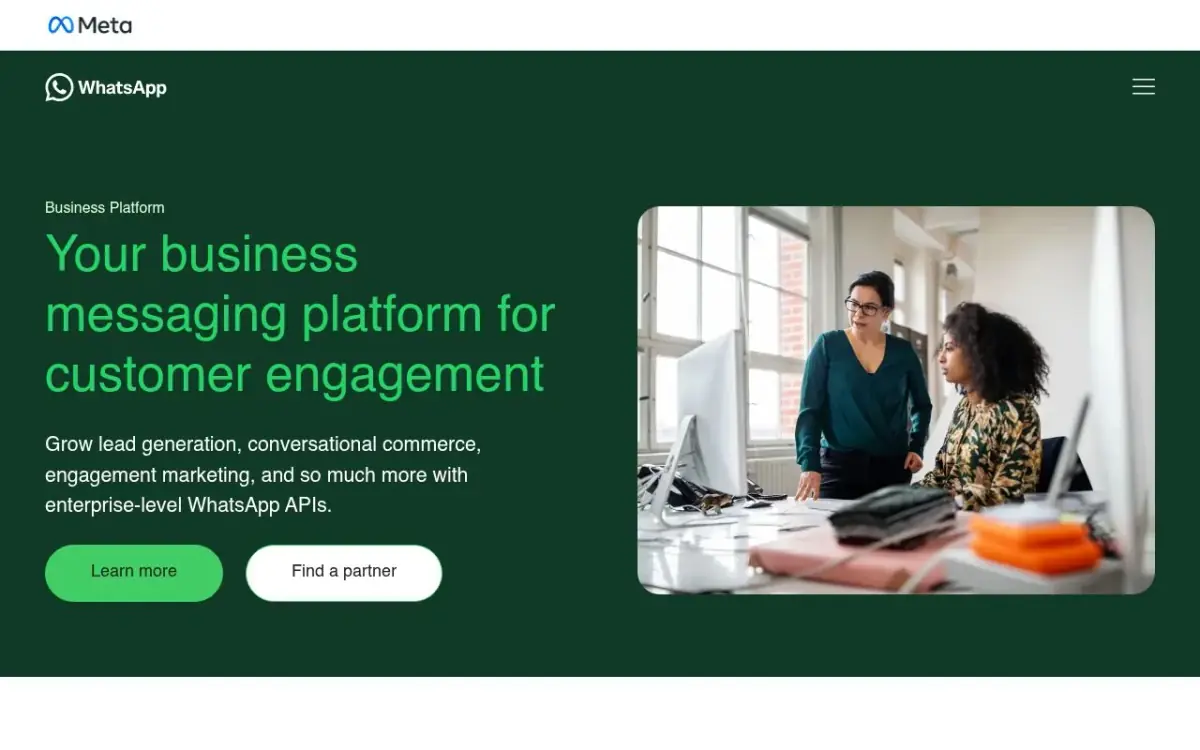
The real answer to how WhatsApp makes money today is the WhatsApp Business Platform, commonly called the WhatsApp Business API. This is the paid infrastructure that lets medium and large companies send notifications, run marketing, and handle support at scale.
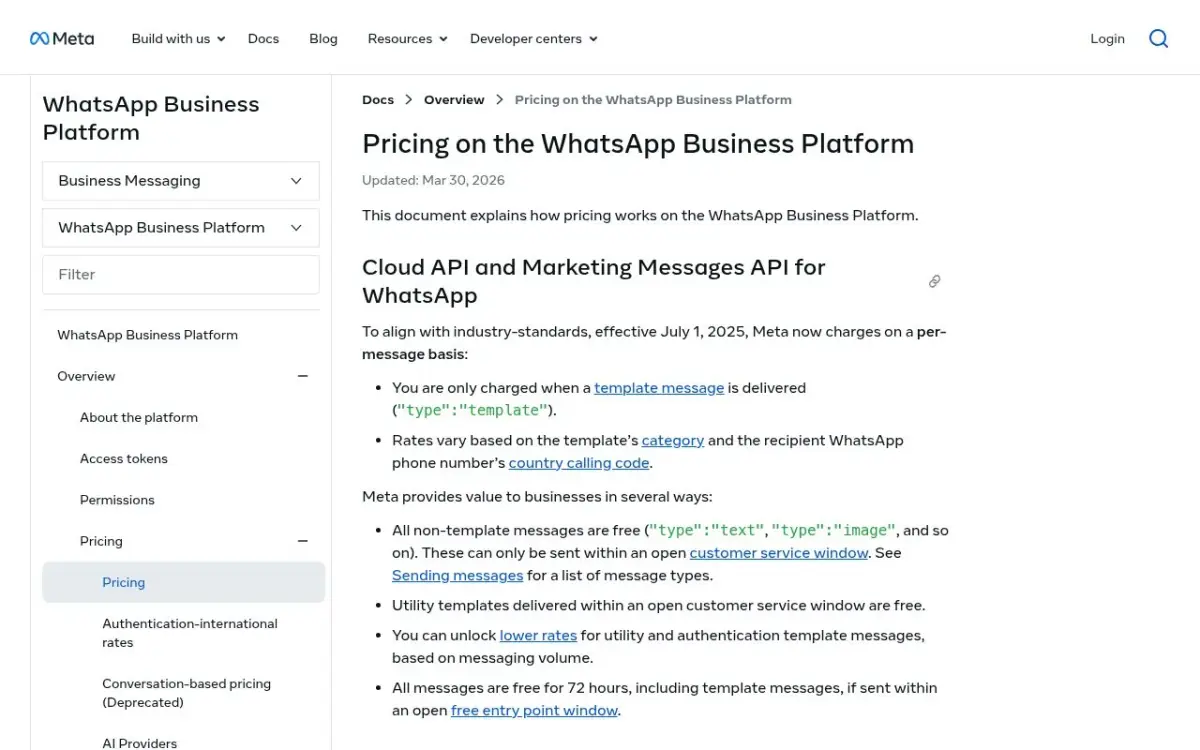
Crucially, Meta bills the API per delivered message. Until June 30, 2025, it billed per 24-hour conversation, charging once for all the messages exchanged in that window. Since July 1, 2025, it charges each template message when it is delivered, not when it is sent, and messages that customers send to a business are never charged (Meta's pricing documentation). Pricing varies along two axes:
- Template category. Meta sorts templates into three categories: marketing, utility, and authentication. Marketing (promotions and campaigns) is the most expensive. Utility (order and shipping updates) is cheaper. Authentication (one-time passcodes) costs the same as utility in the US, Germany and Brazil on Meta's rate card effective October 1, 2026 (Meta's pricing documentation). Service messages are not templates: they are free-form replies inside the 24-hour customer service window that opens when a customer writes in. Meta stopped charging them on November 1, 2024, they stayed free until September 30, 2026, and since October 1, 2026 they cost the utility rate after 1,000 free service messages per business phone number each month, per Meta's pricing documentation.
- Country. Rates differ sharply by the country calling code of the recipient's number. A marketing message costs $0.0118 in India and $0.1365 in Germany on Meta's rate card effective October 1, 2026, per Meta's pricing (list rates per delivered message, detailed in our WhatsApp Business pricing guide).
A newer line sits on top: since August 1, 2026, messages handled by Meta Business Agent, Meta's own AI agent for businesses, are charged per token, at 2.00 dollars per 1 million tokens, according to Meta's pricing documentation. Our Meta Business Agent guide explains how it works.
This per-message model is the main direct revenue stream for WhatsApp. Order confirmations, shipping alerts, passcodes, and promotional campaigns sent by businesses through the API generate fees for Meta. Added up, it becomes a serious business: on its Q4 2025 earnings call, Meta said paid messaging within WhatsApp had crossed a 2 billion dollar annual run-rate. For the full mechanics, see our WhatsApp Business API guide.
How Much Money Does WhatsApp Make?
Meta does not publish WhatsApp's revenue or profit on its own. It reports two segments, Family of Apps and Reality Labs, and Family of Apps includes Facebook, Instagram, Messenger, WhatsApp and other services (Meta 10-Q for Q3 2026). The closest public number is Family of Apps "other revenue", which Meta defines as revenue from paid messaging from WhatsApp, subscriptions, and various other sources:
| Quarter | Family of Apps other revenue | What Meta said drove it |
|---|---|---|
| Q4 2025 | $801 million, up 54% (Q4 2025 call) | WhatsApp paid messaging growth and Meta Verified subscriptions |
| Q1 2026 | $885 million, up 74% (Q1 2026 call) | Primarily WhatsApp paid messaging and subscriptions |
| Q2 2026 | $1 billion for the first time, up 73% (Q2 2026 call) | Primarily WhatsApp paid messaging and subscriptions |
| Q3 2026 | $1,097 million, up 59% (Meta 10-Q) | Primarily paid messaging from WhatsApp and subscriptions |
These totals leave out the advertising that WhatsApp brings to Meta: click-to-WhatsApp ads are booked as Facebook and Instagram ad revenue, and ads in Status are advertising too. So "is WhatsApp profitable?" has no public answer: Meta reports operating income for Family of Apps as a whole, not for WhatsApp.
Click-to-WhatsApp Ads: The Indirect Revenue Stream
The second major way WhatsApp drives revenue is indirect, and Meta has discussed it on its earnings calls: click-to-WhatsApp ads.
These are ordinary ads that appear in the Facebook and Instagram feeds, but instead of sending the user to a website, the call to action opens a WhatsApp chat with the advertiser. A shopper taps the ad and is instantly in a conversation with a business, ready to ask a question or buy.
Meta has put figures on this format. In early 2023, it said click-to-message ads had reached a 10 billion dollar revenue run-rate, a total that covers ads opening a chat in Messenger, Instagram or WhatsApp, not WhatsApp alone. In July 2023, it added that daily click-to-WhatsApp ads revenue was growing at over 80% year-over-year. On its Q4 2025 call, Meta said click-to-message ads revenue growth accelerated, with the US up more than 50% year over year. The money here is not booked as WhatsApp income; it is advertising revenue on Facebook and Instagram. But it exists because WhatsApp does. The app gives advertisers a high-intent destination, which makes the ads more valuable and easier to sell.
In effect, WhatsApp boosts Meta's core advertising machine without placing a single ad inside a personal chat.
The Free WhatsApp Business App: An On-Ramp, Not a Cost
Alongside the paid API, Meta offers the free WhatsApp Business app. This is a separate app aimed at small businesses, with a business profile, a product catalog, quick replies, away messages, and basic labels.
The WhatsApp Business app is free to download and use, and Meta does not earn directly from it. So why offer it at all? Because it is an on-ramp. It introduces small merchants to WhatsApp as a sales tool, gets them comfortable handling customers in chat, and builds the habit.
As those businesses grow, they hit the app's ceiling: no real automation, limited broadcasting, no proper multi-agent support, and no native Shopify integration. To scale past that, they graduate to the paid WhatsApp Business Platform. The free app is the top of Meta's funnel, and the paid API is where the revenue is. Our WhatsApp Business app vs API comparison shows exactly where that transition happens.
Emerging Streams: Payments, Meta Verified, and Channels
Beyond the API and click-to-WhatsApp ads, Meta is building several newer revenue avenues.
- Ads in Status and promoted channels. On June 16, 2025, WhatsApp announced three features for its Updates tab: paid channel subscriptions, promoted channels in the directory and ads in Status. WhatsApp says they appear only in the Updates tab, away from personal chats, and that personal messages, calls and groups are not used to target these ads. In Q1 2026, Meta said hundreds of millions of people were viewing ads in Status daily, and in Q2 2026 that it had added more types of ad destinations and advertiser goals in Status and was on track toward a global rollout.
- Meta Verified for business. Meta Verified is a paid monthly subscription for businesses on WhatsApp, with account support, impersonation protection and the option to apply for a verified badge (About verified business accounts). It is a small but recurring source of income tied directly to WhatsApp.
- AI agents for businesses. In Q2 2026, Meta introduced the Meta Business Agent Platform, which lets large businesses deploy Meta's AI agent on WhatsApp. Its messages are billed per token, as described above.
- Payments. WhatsApp says you can pay registered businesses on WhatsApp in India, Brazil, Mexico and Indonesia, with no timeline for other countries (Learn more about participating countries). In-chat payments make WhatsApp a stronger commerce platform, which in turn supports the business messaging products around it.
Together, they show the direction: more ways to monetize commerce and business activity, with the private inbox left untouched. The assistant built into the app is a separate topic, covered in our guide to Meta AI on WhatsApp, and so is the story of ChatGPT on WhatsApp.
A Note on Privacy: Meta Does Not Sell Your Chats
A common assumption is that WhatsApp must make money by reading messages and selling the data. That is not how it works.
WhatsApp messages are protected by end-to-end encryption, which means only the sender and recipient can read the content. Meta cannot see the text of personal chats, so it cannot sell that content to advertisers. When it announced ads in Status, WhatsApp also wrote that it will never sell or share your phone number to advertisers, and that it targets those ads with limited information such as your country or city, your language and the channels you follow.
WhatsApp monetization is about the business messaging layer and the Updates tab, not the content of private conversations. Meta earns when a company pays for messages delivered through the API, or when an advertiser pays for an ad. It does not earn by mining what you tell your family and friends. This distinction matters: WhatsApp's revenue model is a commerce and messaging-infrastructure model, not a personal-data model built on chat content.
What This Means for Shopify Merchants
If you run a Shopify store, WhatsApp's business model is not just trivia. It directly shapes what WhatsApp marketing costs you.
When you send marketing campaigns, abandoned cart reminders, order updates, or passcodes to customers over WhatsApp, you are using the WhatsApp Business Platform. That means you pay Meta's per-message fees, priced by category and country, exactly as described above. Since October 1, 2026, your replies to customers inside the 24-hour customer service window are also billable beyond 1,000 free service messages per business phone number each month. There is no way around those fees, because they are how WhatsApp makes money.
What you can control is whether your messaging platform adds a markup on top. Tools built on the official WhatsApp Business API, such as Kanal, run on Meta's infrastructure. Kanal passes WhatsApp fees through at cost, with no per-message markup. You see Meta's cost for what it is, plus a clear platform fee for the automation, Shopify integration, and AI agent that turn WhatsApp into a measurable revenue channel. Our pricing page lays out exactly how that breaks down.
The takeaway: budget WhatsApp per delivered message, not per conversation, choose a provider that does not mark up Meta's rates, and weigh each message's fee against the revenue that message brings in.
If you run a business account and want the detail, our pricing guide breaks down what businesses pay per WhatsApp message. And since the platform is reached through providers, we also compare WhatsApp Business API providers.
Conclusion: WhatsApp Makes Money From Businesses, Not Users
So, how does WhatsApp make money? Not from its individual users' chats, which stay free and ad-free. WhatsApp makes money from businesses.
The engine is the WhatsApp Business Platform, where Meta charges companies per delivered message, priced by category and country. Around it sit click-to-WhatsApp advertising, ads in Status and promoted channels, subscriptions such as Meta Verified, and the free WhatsApp Business app as an on-ramp. Through all of it, personal chats stay free, ad-free, and end-to-end encrypted.
It is a smart model: keep the consumer app free to protect the scale, then monetize the businesses that want to reach those users. For a Shopify merchant, that simply means WhatsApp marketing carries Meta's per-message fees, and the right partner passes them through at cost. Book a Kanal demo to see how WhatsApp can become a profitable channel for your store.
Resources
- Kanal demo - see WhatsApp automation for Shopify in action
- Kanal pricing - WhatsApp fees passed through at cost, with no per-message markup
- WhatsApp Business API guide - how the paid platform works
- WhatsApp Business app vs API comparison - free app versus paid platform
- Best Shopify apps - tools worth adding to your store
- WhatsApp Business Platform - Meta's official business product page
- Meta WhatsApp pricing - Meta's official per-message rate card
- Meta quarterly reports - earnings call transcripts and filings
Nicolas helps e-commerce brands grow revenue with WhatsApp marketing. With deep expertise in Shopify ecosystems and conversational commerce, he shares proven strategies for abandoned cart recovery, broadcast campaigns, and AI-powered customer engagement.