Best WhatsApp CRM (2026): 12 Tools and Prices Compared
The best WhatsApp CRM for online stores is Kanal. We compare 12 tools on team inbox, pipelines, store data and prices read on October 30, 2026.
 Nicolas ProvostSep 10, 2026 · 23 min read
Summarize this article with an AI
 ChatGPT
 Claude
Table of contents (23)
Key takeaways
- For an online store, our pick is Kanal: a WhatsApp sales and marketing tool with a team inbox fed by store customers and orders, from €89 a month. It is not a general sales CRM with deal pipelines.
- A WhatsApp CRM links WhatsApp conversations to customer records, with a shared inbox, contact profiles and automation that the WhatsApp Business app does not provide.
- The label covers four kinds of tools: WhatsApp tools for online stores, sales CRMs with WhatsApp, WhatsApp-first platforms and omnichannel inboxes. Choose the kind before the brand.
- The bill has two parts, a subscription priced per plan, per user or per seat, and Meta's WhatsApp fees, which some tools mark up.
- Meta does not currently deliver marketing templates to US phone numbers, whichever tool you pick, so US customers can get support and order updates on WhatsApp, not campaigns.
The best WhatsApp CRM for an online store is Kanal, a WhatsApp sales and marketing tool with a team inbox fed by your store's customers and orders, from €89 a month. It is built for online stores and goes deepest on Shopify. It is not a general sales CRM: there are no deal pipelines, so if your team sells through pipeline stages, look at Kommo, folk or HubSpot below.
Kanal installs from the Shopify App Store and runs on the official WhatsApp Business Platform. It syncs Shopify customers, orders and tags into a team inbox where several agents share one WhatsApp Business number, and it builds segments that feed campaigns and automated flows. It sends WhatsApp messages, with RCS and SMS included from the Scale plan and iMessage coming soon. It does not send email.
Below, we explain what a WhatsApp CRM is and the four kinds of tools behind the label, show how to run WhatsApp as a CRM on Shopify, then compare 12 tools on what they are built for, their store connection and the starting price shown on their own pricing page on October 30, 2026.
What is a WhatsApp CRM?
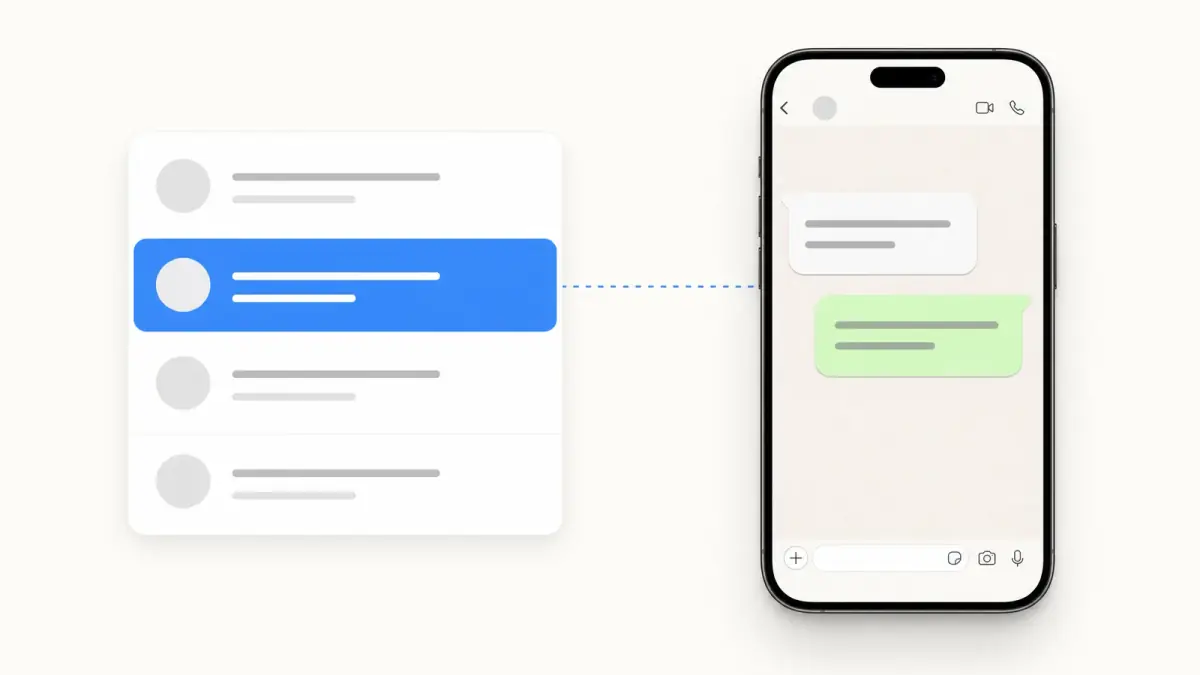
A WhatsApp CRM is software that links WhatsApp conversations to customer records, so a team can reply from one business number, see who each customer is, assign chats and automate follow-ups. It combines a shared inbox, contact profiles, segmentation and automation, with WhatsApp as the primary channel.
Most tools run on the official WhatsApp Business API. The free WhatsApp Business app has labels and quick replies, but no shared team inbox, no order history and no automated flows. Our comparison of the app and the API goes further.
Four kinds of WhatsApp CRM
The label covers software that does different jobs, so choose the kind before the brand.
| Kind | What it does | Tools in this list | Fits when |
|---|---|---|---|
| WhatsApp tool for online stores | Team inbox, campaigns and automated flows fed by store customers and orders | Kanal, Zoko | You sell online and WhatsApp is a sales channel |
| Sales CRM with WhatsApp | Contacts and deals in pipelines, with WhatsApp as one channel | Kommo, HubSpot, folk | Chats need to become tracked deals |
| WhatsApp-first platform | Shared inbox, broadcasts and chatbots on the WhatsApp Business API | Wati, Gallabox, Interakt | WhatsApp is your main contact channel, with or without a store |
| Omnichannel inbox | One inbox for messaging apps, often next to a separate CRM | Respond.io, SleekFlow, Trengo, Superchat | Your team answers on many channels |
Two neighbors are not in the list. Sales CRMs such as Zoho CRM and Pipedrive also connect WhatsApp: on its trial and paid editions for Zoho, and on Growth and above for Pipedrive, where it was still in beta on October 30, 2026. If your deals already live in one of them, check that integration first. Browser extensions for WhatsApp Web add notes, reminders and labels for one person, which is a different job from a shared inbox.
Official API or synced account
How a tool connects decides what it can do. Tools on the official WhatsApp Business API can send approved templates, run campaigns and automate flows, and Meta bills per delivered template. The number often has to leave the app: HubSpot's help center says it must not be connected to the WhatsApp Business app, and Kanal asks the same. Other tools sync an existing account instead: folk connects WhatsApp or WhatsApp Business and syncs messages, contacts and group chats to contact records.
How to run WhatsApp as a CRM on Shopify
A CRM does three jobs: it stores who your customers are, it logs every interaction with them, and it helps you act on that through segments and automation. Running WhatsApp as a CRM means doing all three where customers actually reply.
The WhatsApp Business app stops short of that. You can link devices to it, but there is no conversation assignment and no internal notes, so a team cannot work one number cleanly. A chat shows the messages, not the customer's orders or spend. You cannot target "customers who ordered twice but not in the last 60 days", and every follow-up is typed by hand.
The real version runs on the WhatsApp Business API, with a platform that adds the CRM layer. With Kanal, the setup takes six steps:
- Connect your store. Install Kanal from the Shopify App Store. Customers, orders and tags sync automatically, with no export or manual entry.
- Connect your WhatsApp Business number. Register a new number or migrate an existing one, as long as it is no longer tied to the WhatsApp Business app. Kanal walks you through it during onboarding.
- Open the shared inbox. Agents work the same number, assign conversations, leave internal notes and use quick replies. If your support team lives in Gorgias, conversations that need a human are passed on there.
- Collect WhatsApp opt-in. Use wa.me links and QR codes, the widget, a pop-up, an import with consent or an automation action. Kanal does not sync the Shopify checkout consent box, so plan this before your first campaign, with our guide to WhatsApp opt-in rules.
- Build segments. Group customers by number of orders, orders over a period, how they engaged with your WhatsApp messages (delivered, read, clicked, replied) or the country of their number, using the criteria in our guide to customer segmentation for ecommerce. A Klaviyo or Shopify segment can also be imported once as the audience of a campaign, so you do not rebuild lists you already have.
- Automate the follow-ups. Start flows from store events: a new order, an abandoned cart, a shipping update, a keyword the customer sends on WhatsApp, or an incoming webhook.
Team access beyond a single user, segments, the AI agent and native integrations such as Klaviyo and Gorgias come with the Scale plan.
What it looks like day to day
A customer writes in, and the agent sees their name, their last orders and the note a teammate left last week before typing a word. An abandoned checkout triggers a WhatsApp reminder without anyone lifting a finger. A customer who has just placed a third order drops into the segment that gets early access to the next launch. Nothing lives in a spreadsheet, and nobody asks the customer the same question twice.
How we compared the tools
We only used public pages: pricing pages, product pages, help centers and Shopify App Store listings. No scores, no ratings. Each tool was checked on four points:
- CRM features: contact profiles, shared inbox, assignment, notes and labels, pipelines, segmentation.
- E-commerce integrations: what the vendor documents on its own site or on the Shopify App Store.
- Starting price: the plan price shown on the vendor's pricing page, first read in September 2026 and re-read on October 30, 2026, in the currency the page displayed. Some pages showed euros, or several currencies at once. We did not convert anything.
- WhatsApp fees: whether the vendor says Meta's fees are included, passed through or charged on top.
Prices change often, so check the vendor's page before you buy.
WhatsApp CRM comparison table
| Tool | Kind of tool | Worth a look if | Store connection | Starting price (read on October 30, 2026) |
|---|---|---|---|---|
| Kanal | WhatsApp tool for online stores | You sell online and want store data in a team inbox | Shopify (native app), PrestaShop (store API) | From €89 a month |
| Kommo | Sales CRM with WhatsApp | Your team works leads through pipeline stages | Shopify (built-in integration) | $25 per user/month (Base, billed for 6 months) |
| HubSpot | Sales CRM with WhatsApp | You already run HubSpot | Shopify (Data Sync) | $90 per seat/month paid annually (Service Hub Professional) |
| folk | Sales CRM with WhatsApp | Your sales team wants WhatsApp chats on contact records | None listed (Zapier and Make available) | $24 per member/month (Standard, billed yearly) |
| Respond.io | Omnichannel inbox | You run WhatsApp next to a separate CRM | Shopify (web chat plugin), WooCommerce | $79/month (Starter, billed yearly) |
| Wati | WhatsApp-first platform | You need broadcasts and chatbots next to an inbox | Shopify (add-on), WooCommerce | €59/month (Growth, billed annually) |
| SleekFlow | Omnichannel inbox | You answer on many messaging apps and want flows | Shopify | US$49/month (Essential), US$109/month (Pro), billed yearly |
| Trengo | Omnichannel inbox | Support runs through email as much as chat | Shopify, WooCommerce, PrestaShop, Magento 2 | €299/month (Boost, 10 users, billed annually) |
| Superchat | Omnichannel inbox | You want labels and notes across channels | Shopify via Zapier | Free plan (30 active contacts); Basic €89/month |
| Zoko | WhatsApp tool for online stores | You mostly need campaigns and an inbox on Shopify | Shopify (app) | $49.99/month (Starter) |
| Gallabox | WhatsApp-first platform | Your leads live in HubSpot, Zoho or Pipedrive | Shopify (add-on), Razorpay, Stripe | $112/month (Basic, billed annually) |
| Interakt | WhatsApp-first platform with a Sales CRM plan | You want a simple pipeline next to your inbox | Shopify, WooCommerce | $55/month + taxes (Growth, monthly billing) |
The 12 best WhatsApp CRM tools
1. Kanal, the WhatsApp CRM for online stores
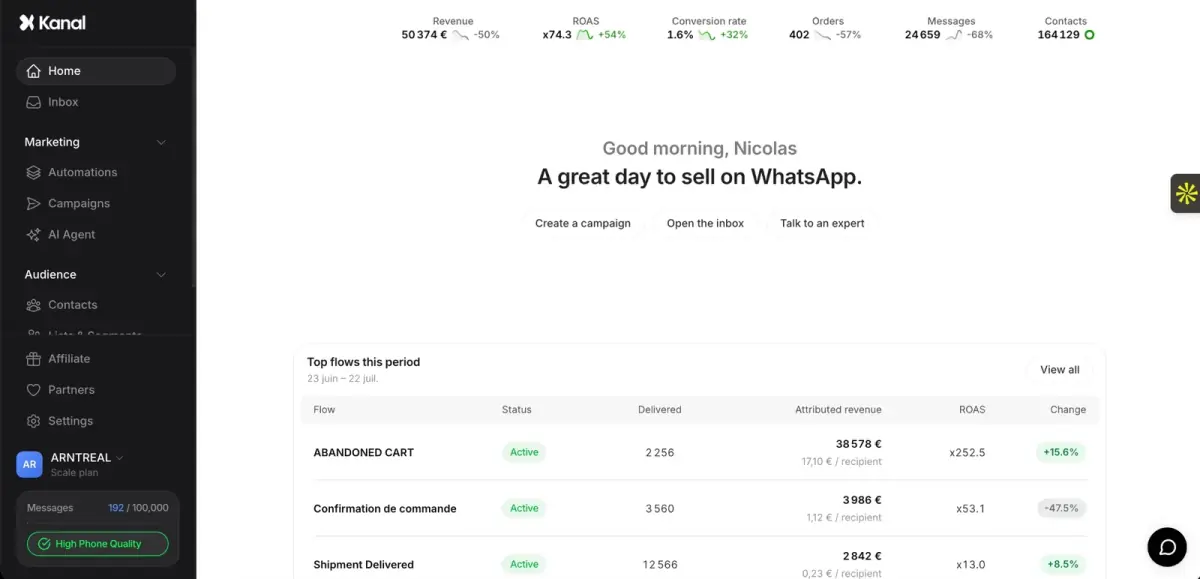 The Kanal app: home dashboard.
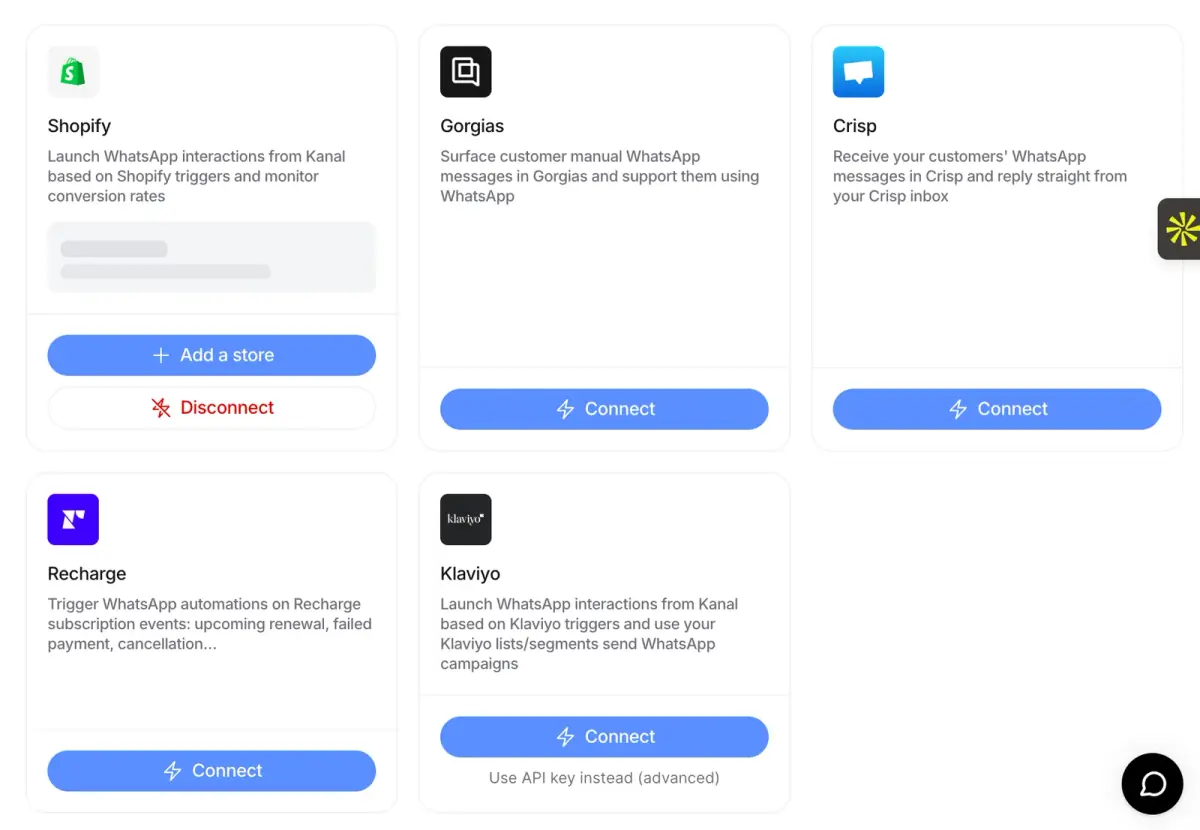 The Kanal app: integrations page.
Kanal is a WhatsApp sales and marketing tool for online stores, used by 500+ brands. We call it a WhatsApp CRM because customers, orders and conversations live together in its team inbox. On Shopify, you install it from the Shopify App Store, and it syncs your customers, orders and tags automatically, with no export or manual entry. Your team knows who they are talking to before they reply.
- CRM features: contact profiles with order history, total spend, tags and past conversations. A team inbox to assign conversations, add internal notes and use quick replies on one WhatsApp Business number. Segments by number of orders, orders over a period, WhatsApp events, phone country or group membership, plus Shopify or Klaviyo segments imported once when you set up a campaign.
- Automation: flows triggered by store events (an order, an abandoned cart, a shipping status, a keyword sent on WhatsApp, an incoming webhook), with conditions, delays and branches, plus abandoned cart recovery and WhatsApp campaigns. An AI agent, on the Scale and Business plans, tracks orders after checking the customer's email and order number, and hands refunds, discounts and cancellations to your team.
- Channels: WhatsApp, with RCS and SMS included from the Scale plan and iMessage coming soon. Kanal does not send email.
- E-commerce integrations: Shopify as a native app, and PrestaShop through the store API, with setup done by a Kanal expert. Native integrations with Klaviyo, Gorgias, Zendesk, Crisp, Recharge, Loyoly and Splio. Conversations that need a human can be passed on to Gorgias, Crisp or HubSpot, from the Scale plan.
- Price: from €89 a month, with Meta fees passed through at cost. The entry plan is for a single user. Team access, segments, the AI agent and native integrations such as Klaviyo and Gorgias come with the Scale plan.
- What it is not: a general sales CRM. There are no deal pipelines. Kanal also does not use the Meta catalog, WhatsApp Flows forms or the Conversions API.
Choose it if you sell online and want your store data, your WhatsApp inbox and your automations in one tool. The WhatsApp CRM page lists every feature.
2. Kommo, a sales pipeline built around messaging
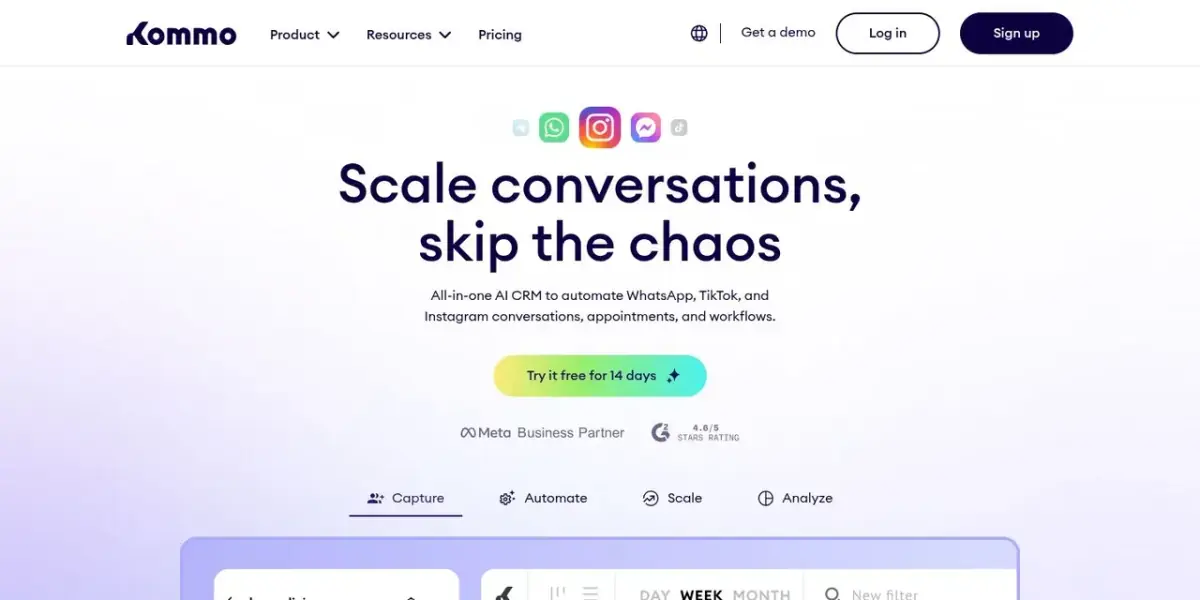 Screenshot of the Kommo website.
Kommo is a CRM organized around sales pipelines, with a unified inbox for WhatsApp and other messengers. Salesbots, built in a no-code editor, can take the first steps of a conversation.
- CRM features: sales pipelines, unified inbox, pipeline automation, broadcasting, salesbots.
- E-commerce integrations: a built-in Shopify integration that syncs products, orders and customer data, with a sales funnel that includes Shopify stages. It is available on all plans.
- Starting price: on Kommo's pricing page on October 30, 2026, Base was $25 per user/month, billed $150 per user for 6 months. Base includes 1 WhatsApp number and 1 Instagram account.
- Trial: 14 days with full access, no credit card.
Worth a look if your team works leads through pipeline stages and WhatsApp is one of several messaging channels.
3. HubSpot, WhatsApp inside an existing CRM
 Screenshot of the HubSpot website.
HubSpot connects a WhatsApp Business Account to its conversations inbox, next to your existing CRM records. It is an add-on channel rather than a WhatsApp-first tool.
- Requirements: Marketing Hub or Service Hub, Professional or Enterprise, and a WhatsApp Business Account. A personal WhatsApp account cannot be connected.
- E-commerce integrations: the Shopify Data Sync integration, available on all HubSpot plans, syncs customers, products, orders and abandoned checkouts.
- Starting price: on October 30, 2026, Service Hub Professional started at $90 per seat/month paid annually ($100 paid monthly), plus a one-time onboarding fee of $1,500. Marketing Hub Professional started at $800/month paid annually ($890 paid monthly), plus a one-time onboarding fee of $3,000. Both pages list the WhatsApp integration with up to 1,000 messages per month. The CRM alone is free for up to 2 users, without WhatsApp.
- Good to know: only new messages sync, not your chat history. Once connected, messages no longer appear in the WhatsApp app, only in HubSpot.
Worth a look if your sales or support team already works in HubSpot and needs WhatsApp in the same records.
4. folk, a CRM that keeps WhatsApp conversations attached to your contacts
 Screenshot of the folk website.
A client sends an update on WhatsApp, but the rest of the team has no record of it. folk helps close that gap by syncing direct conversations to contact profiles. Reps can check previous exchanges, organize leads in pipelines and share the context a teammate needs before taking over a relationship.
- CRM features: contact management, customizable pipelines, WhatsApp conversation sync, contact enrichment, notes and conversation sharing.
- WhatsApp integration: connect WhatsApp or WhatsApp Business to folk. Messages, contacts and group chats sync to the CRM.
- E-commerce integrations: none listed on its integrations page. Zapier and Make connect folk to other apps.
- Starting price: on folk's pricing page on October 30, 2026, $24 per member/month on Standard, billed yearly, or $30 billed monthly. Standard includes email, calendar and WhatsApp sync.
- Trial: 2 weeks with all premium features.
Worth a look if your sales team uses WhatsApp for regular prospect and client conversations and needs to keep contact history and follow-ups organized.
5. Respond.io, lifecycle stages for conversation teams
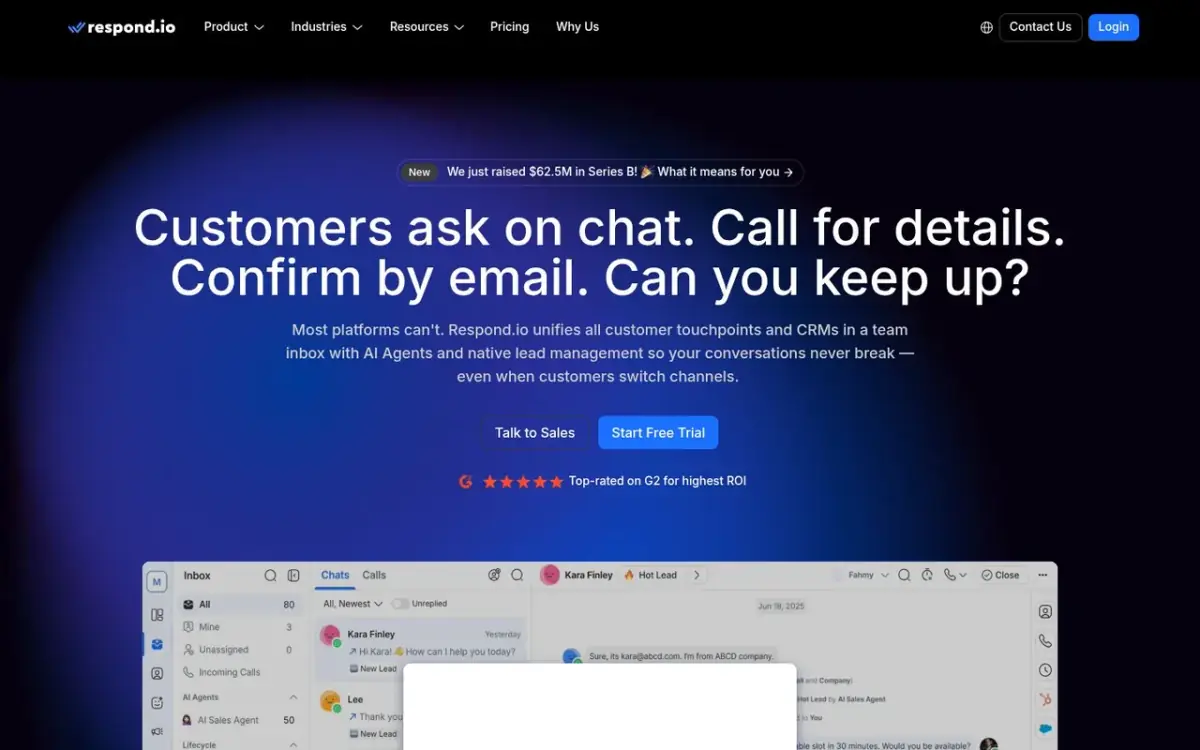 Screenshot of the Respond.io website.
Respond.io is a customer conversation platform priced on the contacts you talk to. Lifecycle management shows where each contact stands in the customer journey.
- CRM features: shared team inboxes, custom inboxes to segment contacts, lifecycle stages.
- Integrations: HubSpot and Salesforce. On the e-commerce side, a web chat plugin for Shopify websites and a WooCommerce integration.
- Starting price: $79/month on Starter with yearly billing ($99 monthly), with 5 users, on respond.io's pricing page on October 30, 2026. There is a 7-day free trial.
- WhatsApp fees: not included in any subscription. Meta charges them based on your usage.
Worth a look if you run WhatsApp next to a CRM like HubSpot or Salesforce and want lifecycle tracking in the inbox.
6. Wati, a team inbox with campaigns and chatbots
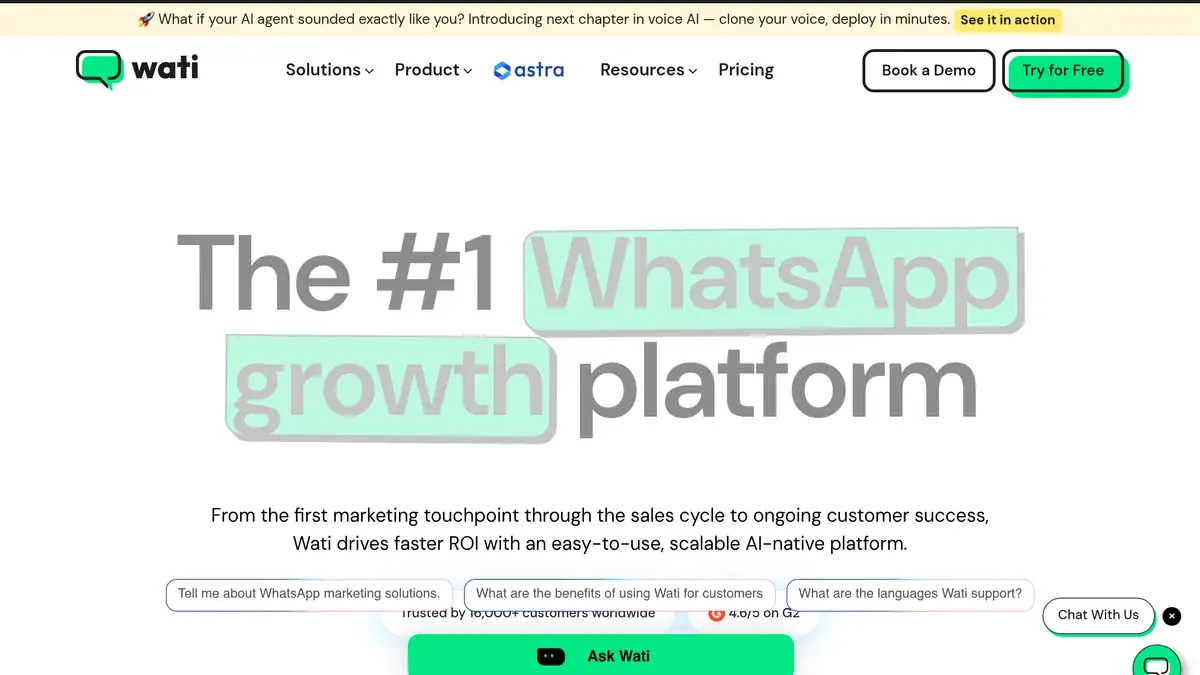 Screenshot of the Wati website.
Wati combines a team inbox with broadcast campaigns and no-code chatbots. Its inbox also covers Instagram, Facebook and TikTok.
- CRM features: a team inbox to assign, track, tag and automate follow-ups. Chatbots and broadcasts.
- E-commerce integrations: a Shopify integration sold as a $4.99/month add-on, with Shopify abandoned cart and order templates. WooCommerce and Klaviyo are listed among its integrations, with HubSpot from the Pro plan and Salesforce on Business. A separate Shopify app, Wati: WA Cart Recovery & AI, is listed from $69/month.
- Starting price: €59/month billed annually on Growth (€69 billed monthly), with 3 users, on Wati's pricing page on October 30, 2026 (shown in euros from France).
- WhatsApp fees: charged on top, per message, by category.
Worth a look if you need broadcasts and chatbots next to a shared inbox. Compare: Kanal vs Wati, or see Wati alternatives.
7. SleekFlow, an omnichannel inbox with flows
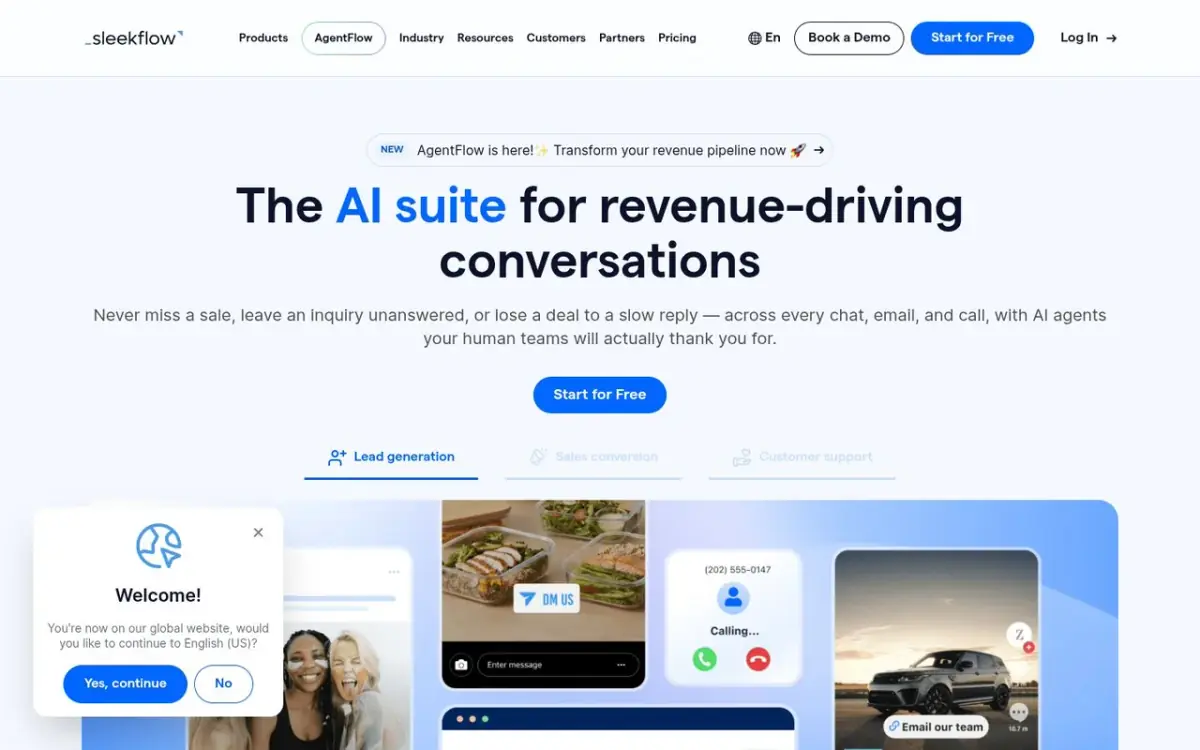 Screenshot of the SleekFlow website.
SleekFlow brings WhatsApp and other messaging apps into one team inbox, with a flow builder and AI agents.
- CRM features: omnichannel team inbox, automation flow builder, broadcast campaigns, AI agents.
- Integrations: Shopify, Google Sheets and API on its plans. HubSpot and Zoho sync on Premium, Salesforce on Enterprise. Its Shopify app sends order confirmations and shipping updates on WhatsApp.
- Starting price: on SleekFlow's pricing page on October 30, 2026, billed yearly: Essential US$49/month (rolling out by country) and Pro US$109/month (US$1,308 a year). A 7-day trial of Pro needs no card.
- WhatsApp fees: a WhatsApp number hosting fee of US$15/month, plus conversation rates from its rate card.
Worth a look if your team answers customers on many messaging apps and wants flows in the same inbox.
8. Trengo, a shared inbox for email and messaging
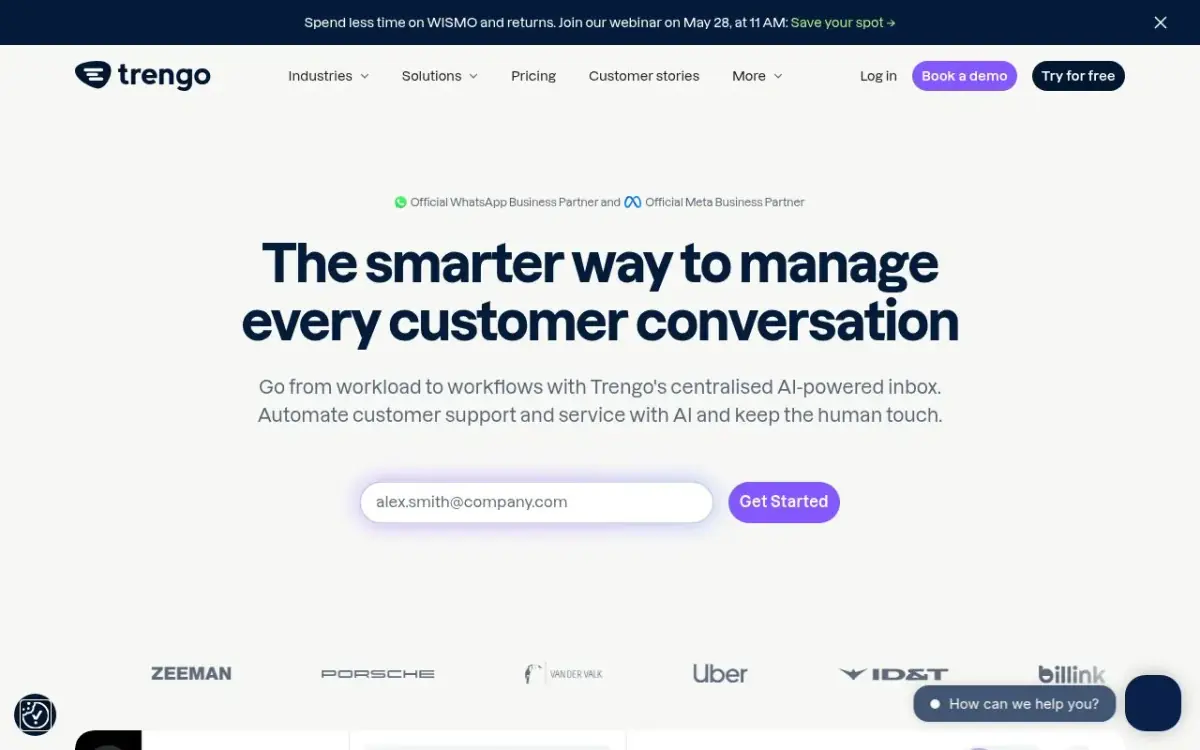 Screenshot of the Trengo website.
Trengo is a shared inbox for email, WhatsApp, Instagram, Facebook and more, with an AI agent called HelpMate.
- CRM features: assign and forward conversations, conversation labels, @mentions and internal comments, custom fields on contacts.
- E-commerce integrations: Shopify, WooCommerce, PrestaShop, Magento 2, Lightspeed and Shopware. CRM integrations include HubSpot, Pipedrive, Salesforce and Zoho CRM.
- Starting price: on Trengo's pricing page on October 30, 2026, €299/month billed annually on Boost (€349 month to month), with 10 users and a set number of conversations (500 per month on monthly billing).
Worth a look if support runs through email and chat as much as WhatsApp. Compare: Kanal vs Trengo, or see Trengo alternatives.
9. Superchat, one inbox for messaging channels
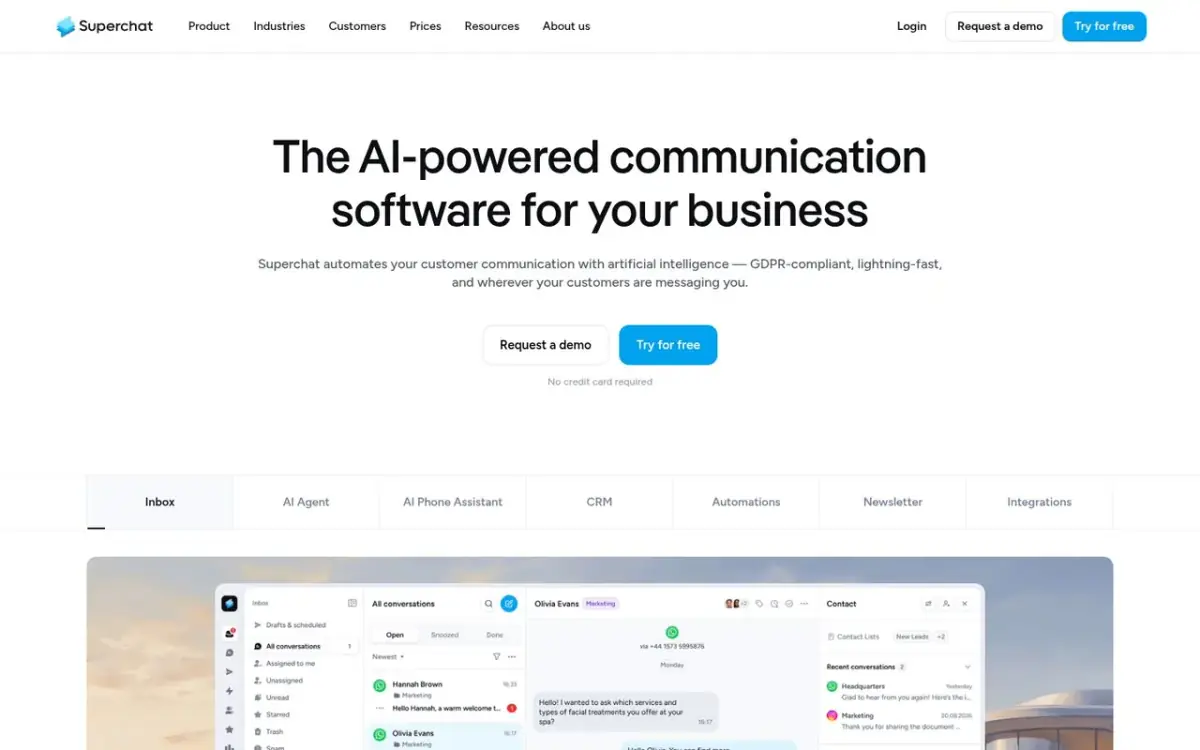 Screenshot of the Superchat website.
Superchat groups WhatsApp, Instagram, Facebook Messenger, Telegram, live chat, email and SMS in one inbox.
- CRM features: unified inbox, chat labels, employee assignment, internal notes, templates, mobile app.
- E-commerce integrations: Shopify through Zapier, according to its help center (new contacts, order tracking messages, abandoned cart messages). Its pricing page lists Zapier, Make and HubSpot.
- Starting price: on Superchat's pricing page on October 30, 2026, a free plan with 1 WhatsApp number, 1 user and 30 active contacts, then Basic at €89/month. Prices are net, with a 12-month minimum term.
Worth a look if you want labels, assignment and notes across several messaging channels, and your store automations can run through Zapier. Compare: Kanal vs Superchat.
10. Zoko, WhatsApp for Shopify brands
 Screenshot of the Zoko website.
Zoko is a WhatsApp tool for Shopify stores, with its app on the Shopify App Store.
- CRM features: multi-agent shared inbox, customer tags and segments, automatic chat distribution, quick replies.
- E-commerce integrations: campaigns sent to Shopify segments (purchases, tags, activity) and a WhatsApp catalog synced from Shopify.
- Starting price: on Zoko's pricing page on October 30, 2026, $49.99/month on Starter, with a markup of $0.015 per conversation. Plus, at $79.99/month, includes 5K conversations without markup. 7-day free trial.
Worth a look if you mostly need WhatsApp campaigns and a shared inbox for a Shopify store. Compare: Kanal vs Zoko.
11. Gallabox, a WhatsApp inbox with CRM connectors
 Screenshot of the Gallabox website.
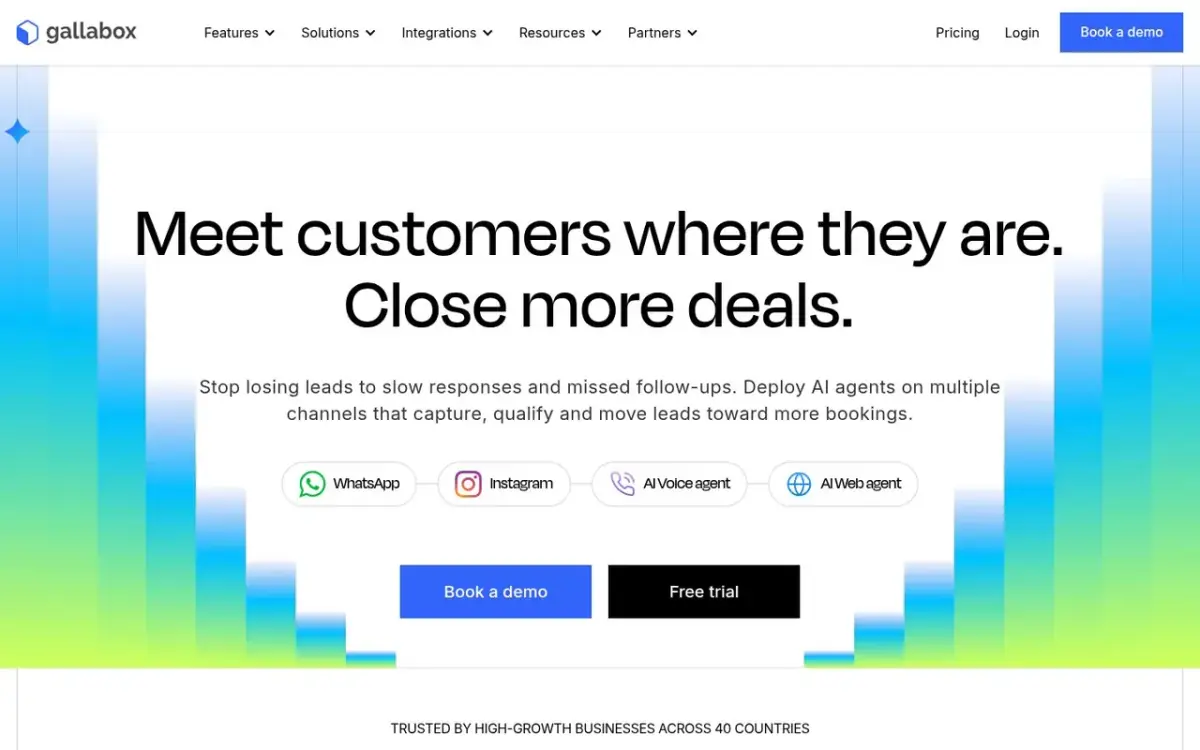
Gallabox is a WhatsApp inbox that connects to sales CRMs, for teams that capture and follow up leads.
- CRM features: WhatsApp shared team inbox, round-robin assignment.
- Integrations: Shopify as a $5/month add-on on all plans, plus Razorpay, Stripe and Shopflo. HubSpot and Zoho from the Essential plan, Pipedrive and Salesforce on Advanced.
- Starting price: on Gallabox's pricing page on October 30, 2026, $112/month billed annually on Basic ($150 billed quarterly), with 3 users. The page also shows prices in rupees and dirhams.
- WhatsApp fees: messaging charges are billed separately.
Worth a look if your leads live in HubSpot, Zoho or Pipedrive and you want to message them on WhatsApp.
12. Interakt, WhatsApp plus a Sales CRM
 Screenshot of the Interakt website.
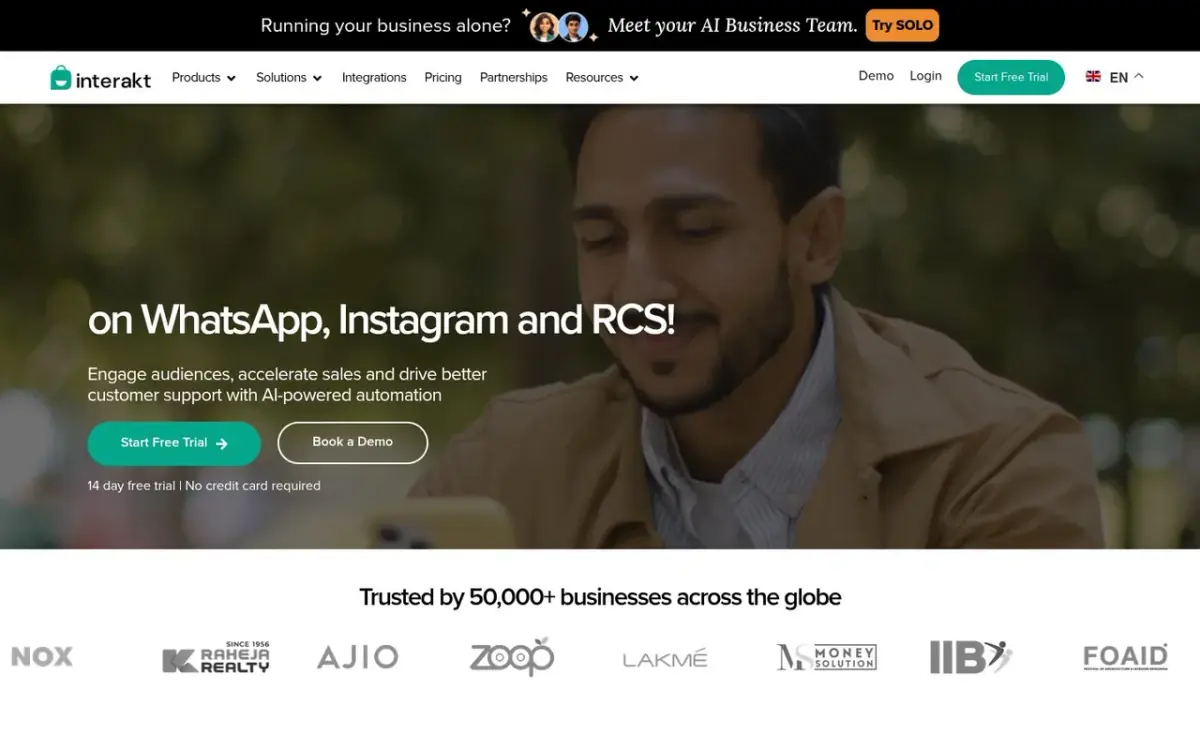
Interakt pairs a WhatsApp inbox with a separate Sales CRM plan for pipelines.
- CRM features: shared team inbox, automatic chat assignment, custom fields and tags. The Sales CRM plan adds sales pipelines and auto-assigns new WhatsApp leads to agents.
- E-commerce integrations: Shopify, with automatic sync of contacts and catalog, and WooCommerce, plus Razorpay and PayU.
- Starting price: on Interakt's US pricing page on October 30, 2026, Growth was $55/month plus taxes on monthly billing. Its Shopify app is listed from $21/month, plus WhatsApp conversation charges. The Sales CRM plan is priced separately.
- WhatsApp fees: message costs depend on the template type. The rates on its pricing page are for Indian numbers.
Worth a look if you want a simple sales pipeline next to your WhatsApp inbox.
What a WhatsApp CRM costs: subscription plus Meta fees
Your bill has two parts.
1. The tool's subscription. Most plans are priced per month. Kommo and folk charge per user, HubSpot Service Hub per seat, and HubSpot's Professional hubs add a one-time onboarding fee. Check how many users a plan includes: 3 on Wati Growth and Gallabox Basic, 5 on Respond.io Starter, 10 on Trengo Boost, and a single user on Kanal's entry plan.
2. Meta's WhatsApp fees. Since July 1, 2025, Meta charges per delivered template message. Rates depend on the message category (marketing, utility, authentication) and on the country calling code of the recipient's number. Replies inside the 24-hour customer service window were not charged until September 30, 2026. Since October 1, 2026, Meta charges these service messages per message, at the utility rate of each market, after 1,000 free service messages per business phone number each month. The details are on Meta's pricing page.
Each tool handles those fees in its own way:
- Kanal passes Meta fees through at cost.
- Respond.io says WhatsApp fees are not included in any subscription.
- Wati charges messages on top, by category.
- Zoko says you pay Meta directly, and adds $0.015 per conversation on Starter. Its higher plans include conversations without markup.
- SleekFlow adds a WhatsApp number hosting fee of US$15/month, plus the conversation rates on its own rate card.
- Gallabox bills messaging charges separately.
For rates by country and a full cost model, read our WhatsApp Business pricing guide.
Can a WhatsApp CRM message US customers?
Yes, with one limit that applies to every tool in this list, Kanal included. Meta's page on per-user marketing limits states that WhatsApp does not currently deliver marketing template messages to users with United States phone numbers (a +1 dialing code with a US area code).
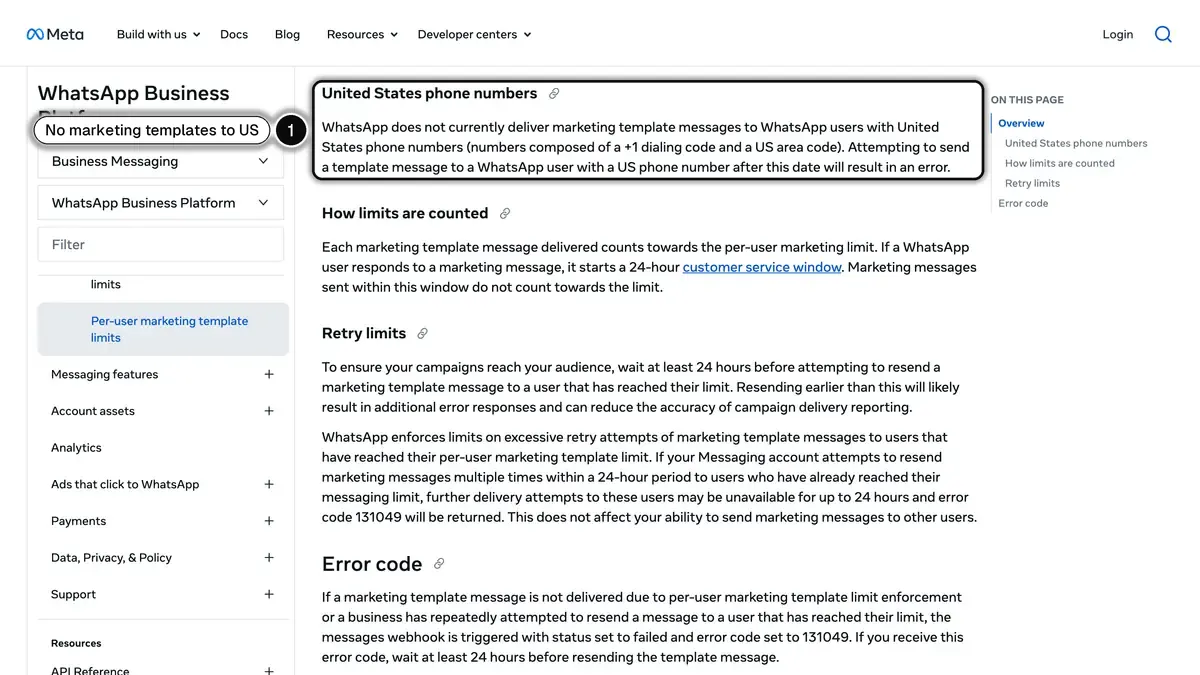 Source: Meta for Developers, Per-user marketing template message limits, read on October 25, 2026. In 1, the rule for United States phone numbers.
So campaigns and cart reminders do not reach US numbers on WhatsApp. The rule names marketing templates only: order confirmations and shipping updates (utility) and replies to customers who write first (service) are separate categories. A store with US customers can still use a WhatsApp CRM for support and order updates, and needs another channel for promotions to those numbers. Kanal includes SMS from the Scale plan. Our guide to WhatsApp marketing in the USA goes further.
How to choose a WhatsApp CRM
Start from how you sell, not from the feature list.
- You run an online store and want an inbox, automation and campaigns in one place: Kanal. Customer and order data from Shopify, or PrestaShop, feeds every conversation, and flows run on store events.
- Your team works deals in a pipeline: Kommo, folk, or Interakt's Sales CRM plan.
- You already run HubSpot: connect WhatsApp to a Professional or Enterprise hub.
- Support runs on many channels: Trengo, Superchat, Respond.io and SleekFlow bring email, social and messaging apps into one inbox.
- Your leads sit in another CRM: Gallabox and Respond.io connect to HubSpot, Salesforce and others.
- Several agents share a high volume of chats: compare assignment rules plan by plan. Gallabox lists round-robin assignment, Wati auto routing on its Pro plan and Interakt chat auto-assignment on its Advanced plan.
Before you sign, check five things:
- Store data in the inbox: can an agent see orders and spend next to the chat, or only a name and a phone number?
- Users included: price the plan for your real team size.
- WhatsApp fees: included, passed through at cost, or marked up? Ask for the rate card.
- The connection: official API or a synced account, and does your number have to leave the WhatsApp Business app?
- Opt-in: how does the tool collect and record WhatsApp consent?
If support is your main use case, our guide to WhatsApp customer support on Shopify goes further. For marketing tools, see our WhatsApp marketing software comparison. For CRMs beyond WhatsApp, see our ecommerce CRM comparison and our list of CRM apps for Shopify.
If you sell on Shopify or PrestaShop, book a Kanal demo to see your own store data inside a WhatsApp CRM, or compare Kanal's plans.
See Kanal on your own store
- Your campaigns and cart reminders on WhatsApp, starting from your own store
- Post-purchase offers, back-in-stock alerts, then the AI agent that advises your customers
- You leave with the plan that fits and its price
From €89/month
- brands
- 500+
- to set up
- 5 min
- open rate on WhatsApp
- +90%
Nicolas helps e-commerce brands grow revenue with WhatsApp marketing. With deep expertise in Shopify ecosystems and conversational commerce, he shares proven strategies for abandoned cart recovery, broadcast campaigns, and AI-powered customer engagement.